
ZEP Quiz
ZEP Quiz
NAVER Z CORP
NAVER Z CORP
Making it safe to be wrong
Making it safe to be wrong
ZEP Quiz is a gamified quiz platform where students play and answer live in class. I designed and shipped its first AI learning assistant: pet companions that review each student's mistakes with them, one on one.
ZEP Quiz is a gamified quiz platform where students play and answer live in class. I designed and shipped its first AI learning assistant: pet companions that review each student’s mistakes with them, one on one.
ZEP Quiz is a gamified quiz platform where students play and answer live in class. I designed and shipped its first AI learning assistant: pet companions that review each student’s mistakes with them, one on one.
Role
Role
Task Owner
Product Design Lead
Task Owner
Product Design Lead
Timeline
Timeline
6 Months
(Mar - Aug 2025)
6 Months
(Mar - Aug 2025)
Team
Team
NAVER Z Corp.
ZEP Quiz AI TF
NAVER Z Corp.
ZEP Quiz AI TF
Context
Context
ZEP Quiz is a live quiz platform for classrooms. Teachers run quizzes, students answer in real time. But when the quiz ended, the learning stopped.
ZEP Quiz is a live quiz platform for classrooms. Teachers run quizzes, students answer in real time. But when the quiz ended, the learning stopped.
Problem
Problem
Teachers couldn't check on every student, and students couldn't easily ask about what they didn't know. Mistakes went unreviewed.
Teachers couldn’t check on every student, and students couldn’t easily ask about what they didn’t know. Mistakes went unreviewed.
Solution
Solution
I designed and shipped AI pet companions: students choose one before the quiz, it plays alongside them, then reviews mistakes in a private 1:1 chat. Teachers get an insight view.
I designed and shipped AI pet companions: students choose one before the quiz, it plays alongside them, then reviews mistakes in a private 1:1 chat. Teachers get an insight view.
Outcome
Outcome
After classroom testing, the assistant shipped as a Premium feature. In its first two months, 82% of paid users tried it, 68% came back, and students sent 9.3 messages per student per quiz on average in quizzes where the feature was used.
After classroom testing, the assistant shipped as a Premium feature. In its first two months, 82% of paid users tried it, 68% came back, and students sent 9.3 messages per student per quiz on average in quizzes where the feature was used.
Active Paid-user usage
Active Paid-user usage
82%
82%
within 2 months of launch
within 2 months of launch
Avg. chat messages
Avg. chat messages
9.3
9.3
sent per student per quiz
sent per student per quiz
Reuse rate
Reuse rate
68%
68%
teachers set the feature again
teachers set the feature again
Product Background
Product Background
What is ZEP Quiz?
What is ZEP Quiz?
ZEP Quiz is NAVER Z's gamified quiz platform where students join as avatars and answer live quizzes in a shared 2D world.
ZEP Quiz is NAVER Z’s gamified quiz platform where students join as avatars and answer live quizzes in a shared 2D world.
37M+
37M+
cumulative quiz plays
cumulative quiz plays
78%
78%
Korean K-12 schools
Korean K-12 schools
72%
72%
of users are outside Korea
of users are outside Korea
80K+
80K+
global teachers
global teachers
Korea's First Google Education Partner
Korea's First Google Education Partner


Defining Problem
Defining Problem
The learning stopped when the quiz ended.
The learning stopped when the quiz ended.
Students solve quizzes in real time while teachers watch class-wide progress. The flow had three stages: Content Learning, Quiz Session, and Result Check. Review & Feedback was missing. Once a quiz ended, mistakes went unreviewed and gaps widened.
Students solve quizzes in real time while teachers watch class-wide progress. The flow had three stages: Content Learning, Quiz Session, and Result Check. Review & Feedback was missing. Once a quiz ended, mistakes went unreviewed and gaps widened.
Content Learning
Content Learning
Quiz Session
Quiz Session
Result Check
Result Check
Review & Feedback
Review & Feedback
Field research
Field research
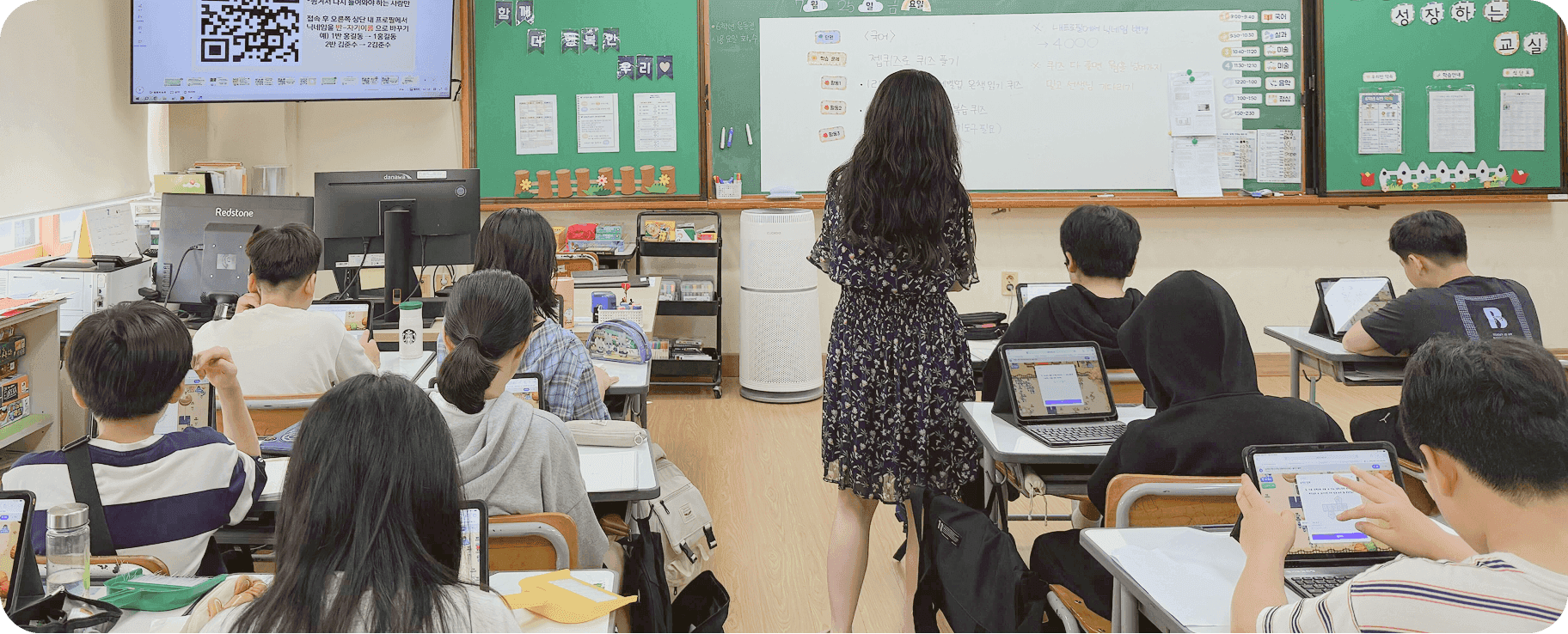
I went into real classrooms for observations, student interviews, and teacher focus groups to see what happens after the quiz ends.
I went into real classrooms for observations, student interviews, and teacher focus groups to see what happens after the quiz ends.

Gaps widened quietly
Gaps widened quietly
Mistakes stayed unreviewed, so
small misunderstandings became
larger learning gaps.
Mistakes stayed unreviewed, so
small misunderstandings became
larger learning gaps.

30+ students, one teacher
30+ students, one teacher
Teachers could not address every
individual misunderstanding in real
time.
Teachers could not address every
individual misunderstanding in real
time.

Students moved on
Students moved on
After a quiz, most students did not
ask about incorrect answers.
After a quiz, most students did not
ask about incorrect answers.
Students weren't unwilling to ask.
They didn't feel safe asking.
Students weren’t unwilling to ask. They didn’t feel safe asking.
Students weren’t unwilling to ask.
They didn’t feel safe asking.
I initially assumed this was a motivation problem. Field research showed that students had questions but avoided judgment in front of 30+ classmates. They also had no structured moment to reflect.
I initially assumed this was a motivation problem. Field research showed that students had questions but avoided judgment in front of 30+ classmates. They also had no structured moment to reflect.


The Idea
The Idea
What if review felt like talking to a friend?
What if review felt like talking to a friend?
Students needed a private, low-pressure way to work through mistakes without feeling exposed.
Students needed a private, low-pressure way to work through mistakes without feeling exposed.
The question evolved through three rounds of reframing
The question evolved through three rounds of reframing
01
How can students ask more questions?
How can students ask more questions?
02
How can we help students reflect on their mistakes without forcing them to speak up?
How can we help students reflect on their mistakes without forcing them to speak up?
03
How can reviewing mistakes feel more like a private, supportive conversation?
How can reviewing mistakes feel more like a private, supportive conversation?
How Might We
How Might We
Make review feel safe, personal, and naturally embedded into the quiz flow?
Make review feel safe, personal, and naturally embedded into the quiz flow?
Prompt design
Teaching the companion to teach.
The companion's behavior was designed in prompts, not pixels. I wrote and iterated on the prompts myself, testing each version against real classroom scenarios.
1
Never gives the answer directly.
It asks guiding questions so students reason it out themselves.
2
Redirects off-topic questions.
It keeps the conversation safe and focused in a classroom for kids.
3
Answers in two to three sentences.
Written for young students, who skim.
Solution
Solution
Intergrating Support into the Learning Flow
Intergrating Support into the Learning Flow
Generic answers were not enough. I designed the interpretation layer to respond to each student's reasoning while keeping the companion's voice consistent.
Generic answers were not enough. I designed the interpretation layer to respond to each student’s reasoning while keeping the companion’s voice consistent.
AI pet friend
for personalized review and support
AI pet friend
for personalized review and support
Follows students through quiz sessions and provides personalized review afterward
Follows students through quiz sessions and provides personalized review afterward


For Students
For Students
Uses student-written reasoning to generate personalized explanations
Uses student-written reasoning to generate personalized explanations
For Teachers
For Teachers
Data provides insight on class-level & individual misunderstanding patterns.
Data provides insight on class-level & individual misunderstanding patterns.
Design Output
Design Output
Solutions at a glance
Solutions at a glance
AI Pet Companions
AI Pet Companions
Students choose their companion before the quiz starts, so it already feels familiar when review begins.
Students choose their companion before the quiz starts, so it already feels familiar when review begins.

Student Review Chat
Student Review Chat
A private 1:1 space where students revisit their own mistakes.
A private 1:1 space where students revisit their own mistakes.

Teacher Insight View
Teacher Insight View
A window into the misunderstandings a class never says out loud.
A window into the misunderstandings a class never says out loud.

Part 1
Part 1
1
1
AI Pet Companions
AI Pet Companions
Students read each companion's sample texts and pick the personality that fits them. When review begins, it comes from a friend they chose themselves.
Students read each companion’s sample texts and pick the personality that fits them. When review begins, it comes from a friend they chose themselves.

Choosing a companion
Choosing a companion
Students read each companion's sample texts and pick the personality that fits them. When review begins, it comes from a friend they chose themselves.
Students read each companion’s sample texts and pick the personality that fits them. When review begins, it comes from a friend they chose themselves.


Together during the quiz
Together during the quiz
The companion walks the map alongside the student, reacting to every answer as it lands. A cheer for the right ones comes while the quiz game is still going.
Students read each companion’s sample texts and pick the personality that fits them. When review begins, it comes from a friend they chose themselves.
Part 2
Part 2
2
2
Student Review Chat
Student Review Chat
Students review missed questions in a private 1:1 chat inside the quiz flow.
Students review missed questions in a private 1:1 chat inside the quiz flow.
User Goals & Features
User Goals & Features
Private 1:1 Space
Private 1:1 Space
Students can return to missed questions in a private chat.
Students can return to missed questions in a private chat.
Personal Explanations
Personal Explanations
Feedback uses each student's written reasoning.
Feedback uses each student’s written reasoning.
Embedded in the Flow
Embedded in the Flow
Review stays inside the existing quiz flow.
Review stays inside the existing quiz flow.
Desktop Modal
Desktop Modal
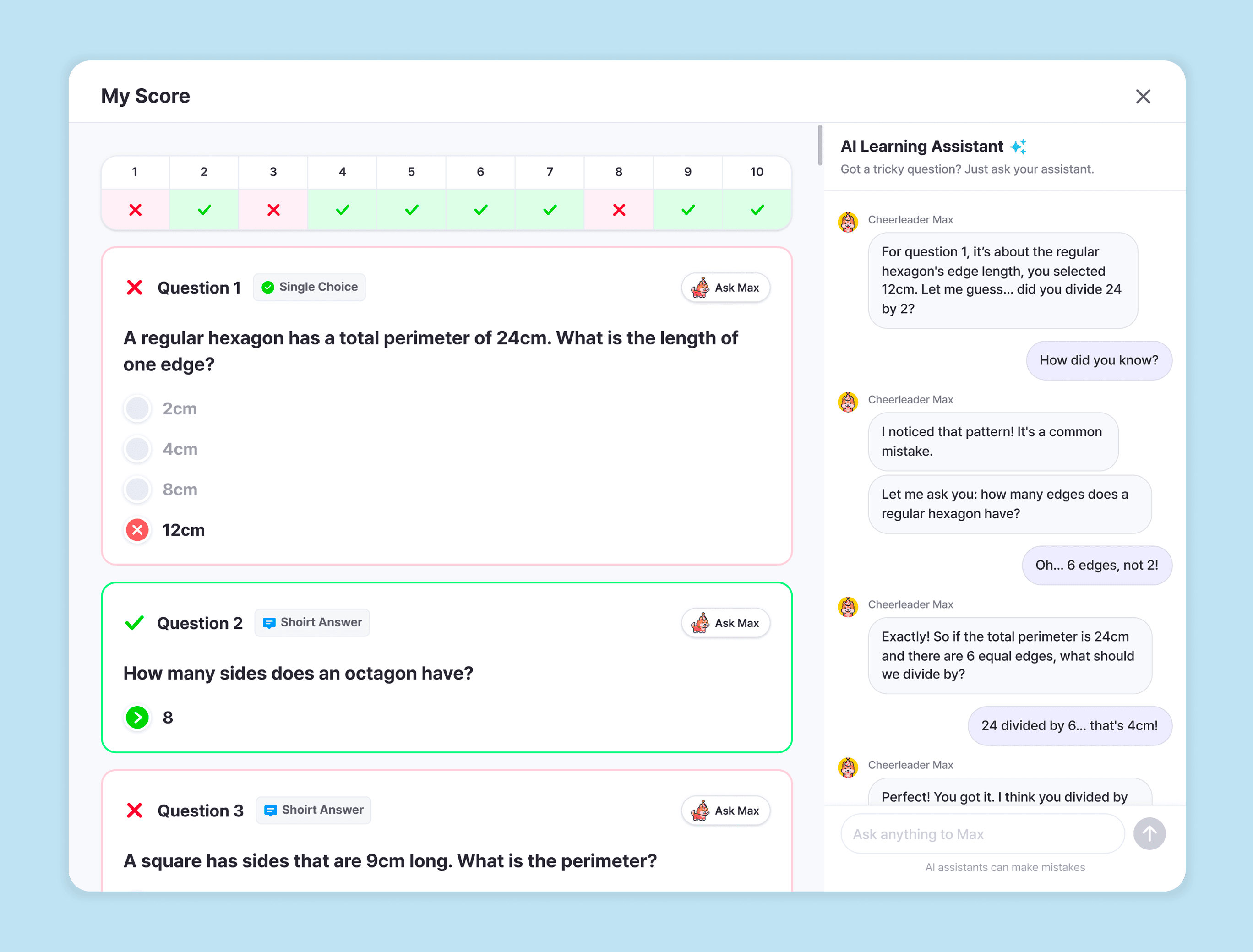
My Score opens right after the quiz with every question marked. For each miss, the companion asks how the student got there, then works through the reasoning together.
Students read each companion’s sample texts and pick the personality that fits them. When review begins, it comes from a friend they chose themselves.

Mobile
Mobile
The same review fits on a phone. Students switch between their answer sheet and the companion's chat with one tap, so they can review wherever they played.
Students read each companion’s sample texts and pick the personality that fits them. When review begins, it comes from a friend they chose themselves.

Quiz full view
Quiz full view
Review happens on top of the game world itself. Students fix their mistakes in the same place they made them and jump right back into the map.
Students read each companion’s sample texts and pick the personality that fits them. When review begins, it comes from a friend they chose themselves.
Part 3
Part 3
3
3
Teacher Insight View
Teacher Insight View
Teachers see each student's learning gaps and class-wide misunderstanding patterns through chat details and use them to adjust the next lesson.
Teachers see each student’s learning gaps and class-wide misunderstanding patterns through chat details and use them to adjust the next lesson.
User Goals & Features
User Goals & Features
Find Individual Gaps
Find Individual Gaps
Teachers see each student's learning gaps and misunderstanding patterns through chat details.
Teachers see each student’s learning gaps and misunderstanding patterns through chat details.
Class-Wide Patterns
Class-Wide Patterns
When multiple students share the same misconception, the pattern surfaces across the full chat history.
When multiple students share the same misconception, the pattern surfaces across the full chat history.
Next-Lesson Adjustment
Next-Lesson Adjustment
Teachers use what the class could not say out loud to adjust the next lesson.
Teachers use what the class could not say out loud to adjust the next lesson.

Outcomes
Outcomes
What happened after launch
What happened after launch
After user testing, the assistant shipped as part of the ZEP Quiz Premium plan.
After user testing, the assistant shipped as part of the ZEP Quiz Premium plan.
82%
82%
Active Paid-user usage
Active Paid-user usage
Within 2 months of launch.
Within 2 months of launch.
68%
68%
Reuse rate
Reuse rate
Used the feature again.
Used the feature again.
9.3
9.3
Avg. chat messages
Avg. chat messages
Sent per student per quiz in quizzes where the feature was used.
Sent per student per quiz in quizzes where the feature was used.
“The update my students loved and responded to the most. It also showed me what they hadn't been asking about, which was genuinely useful when planning my next lessons.”
“The update my students loved and responded to the most. It also showed me what they hadn’t been asking about, which was genuinely useful when planning my next lessons.”
“The update my students loved and responded to the most. It also showed me what they hadn’t been asking about, which was genuinely useful when planning my next lessons.”
Teacher Jintae Choi, Gwan-ak Elementary School
Teacher Jintae Choi, Gwan-ak Elementary School




Active engagement
Active engagement
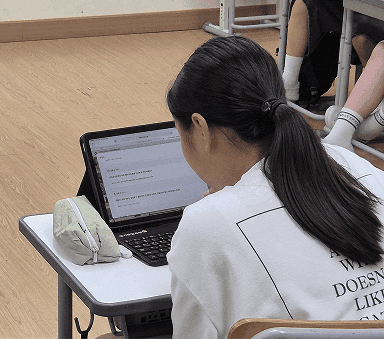
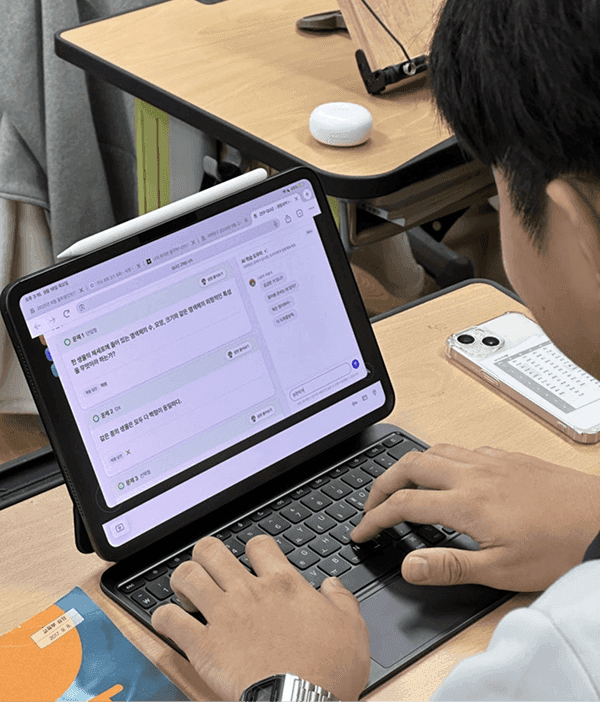
Students who normally stayed passive became active participants, voluntarily opening the review chat after quizzes.
Students who normally stayed passive became active participants, voluntarily opening the review chat after quizzes.

Deep immersion
Deep immersion
Students stayed focused during the review chat.
Students stayed focused during the review chat.

Psychological safety
Psychological safety
The private, non-judgmental chat lowered the emotional barrier to asking questions.
The private, non-judgmental chat lowered the emotional barrier to asking questions.
Reflections
Reflections
What I learned
What I learned
1
1
Designing for students also meant designing for teacher trust.
Designing for students also meant designing for teacher trust.
Improving the student experience was not enough. The product also had to make teachers feel informed, supported, and in control.
Improving the student experience was not enough. The product also had to make teachers feel informed, supported, and in control.
2
2
Good AI experiences reduce the cost of being wrong.
Good AI experiences reduce the cost of being wrong.
Students were more willing to reveal confusion when asking felt private and judgment-free. Designing that sense of safety became as important as designing the answer itself.
Students were more willing to reveal confusion when asking felt private and judgment-free. Designing that sense of safety became as important as designing the answer itself.


Next Project
Quiz Detail Renewal
